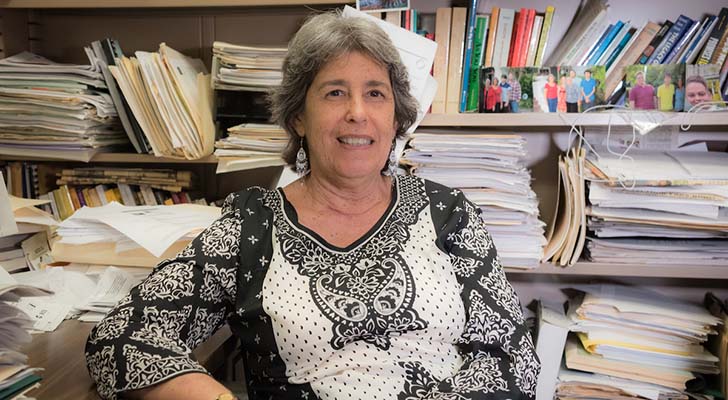
USF Anthropology Professor Roberta Baer, PhD, and students in her recently launched Oral History course are using those stories to help newly arrived refugees build their futures.
“Refugees leave everything behind. What they have left is their stories. It is a wonderful contribution to be able to record those stories and turn them into a useful product that will help new refugees learn English and help others better understand the refugee experience,” Dr. Baer said.
In fall 2016, Dr. Baer offered her Oral History course for the first time. During the class, she taught her students the various steps and considerations involved in conducting oral histories.
To apply what they were learning in the classroom, Dr. Baer had her students interview local refugees. Dr. Baer identified willing interviewees through her numerous contacts within the refugee community.
Working in pairs, the students conducted their interviews in public locations, such as coffee shops, and followed Dr. Baer’s instructions to let the refugees decide what parts of their stories they would share.
“Some of the refugees have seen their families be kidnapped, killed or tortured,” Dr. Baer said. “We were careful to respect their privacy.”
By the end of the fall semester, 19 students had conducted 21 interviews with refugees representing countries such as Afghanistan, Bosnia, Burma, Democratic Republic of the Congo, Cuba, Haiti and Somalia.
A grant from USF’s Office of Community Engagement and Partnerships paid for the development of the course as well as the transcription of the students’ interviews.
From the transcripts, Dr. Baer and her graduate assistant, Emily Holbrook, have turned the interviews into a volume of stories written at about a fourth-grade level. University Communications Multimedia News Manager Sandra C. Roa is providing portraits of willing interviewees to illustrate the book, which is on track to be finished by August.
When complete, CARIBE, a federally funded English-language program for refugees that is offered through the Hillsborough County Public Schools, will use the book, titled “American Stories,” to help newly arrived refugees learn English — and feel less alone in their new country.
“The book will be used as a learning tool for our English-language classes, allowing refugees to learn English by reading informational texts that are culturally relevant to them. The stories will inspire and motivate by highlighting the journey of refugees from their native country to the United States,” said Ronald Allan Cruz, CARIBE coordinator.
“It will make a difference for the refugees to read about something they’ve experienced or can relate more easily to; it will make it easier for them to comprehend what they’re reading. It will also help them to see they are not alone and help them understand that their lives will not be immediately perfect when they come here. They will encounter some struggles, but success is achievable.”
CARIBE will also provide a copy of the book to every K-12 school library within the Hillsborough County School District, Cruz said.
“Having these books in the libraries will give refugee children the chance to learn English while reading about struggles similar to the ones their parents faced when they came to the United States. Among all children, these books will promote tolerance and diversity. There is such a negative connotation to the word ‘refugee.’ These stories will show positivity, and that refugees are working hard to build new lives here.”
Dr. Baer witnessed the educational power of the refugees’ stories among her own students. At the end of the semester, her students wrote reflection papers on their experiences with the refugees. A few excerpts:
Something I never considered before taking this class was that even if a refugee does gain refugee status, that doesn’t necessarily mean that their loved ones will. The great lengths they have to go through to find a job, to go to the doctor, to get prescriptions, and to better their lives is incredible. They must completely start over, learn a new language, and leave behind what they were once comfortable with. Asking anyone to do that is difficult.
One of the things I learned in this class that will probably have the biggest impact on me is the fact that refugees don’t all fit into this singular mold of “just a refugee.” Not only are they people but they are unique individuals and families. They come from all walks of life, varying levels of education, different backgrounds, religions, ethnicities, etc. In fact, the only thing all refugees have in common with each other is that they have been forced to leave their home country.
I wasn’t sure how I felt about refugees before this class because I never gave the situation much thought. I didn’t think they were bad people who deserved to be sent back or held up in camps for years on end, but I also didn’t understand their lack of agency in the countries they were fleeing. People are refugees because they are running for their lives. Crossing a dangerous sea is a better promise of life than staying in their own homes. It is a disturbing and unsettling thought that most people of the world can’t relate to and don’t.
Dr. Baer has worked with refugees throughout Tampa Bay for the better part of a decade, conducting numerous studies and leading her students in other service-learning projects, such as contributing to the creation of a community garden in southeast Tampa, where refugees grow food to feed their families and forge connections with one another.
She plans to have students begin working on a second collection of refugee stories in 2018. The materials she and her students are creating for CARIBE may eventually be offered digitally to similar programs nationwide.
“This project is a win on every level. For the students who conduct the interviews and gain firsthand perspective of the refugee experience, to the refugees who are able to make connections with college students, to the refugees who will learn English through the use of these stories. Our hope is that we can contribute to a fuller understanding of the refugee situation in the United States.”
Story by Rachel Pleasant, University Communications & Marketing, Photo by Sandra C. Roa, University Communications & Marketing